
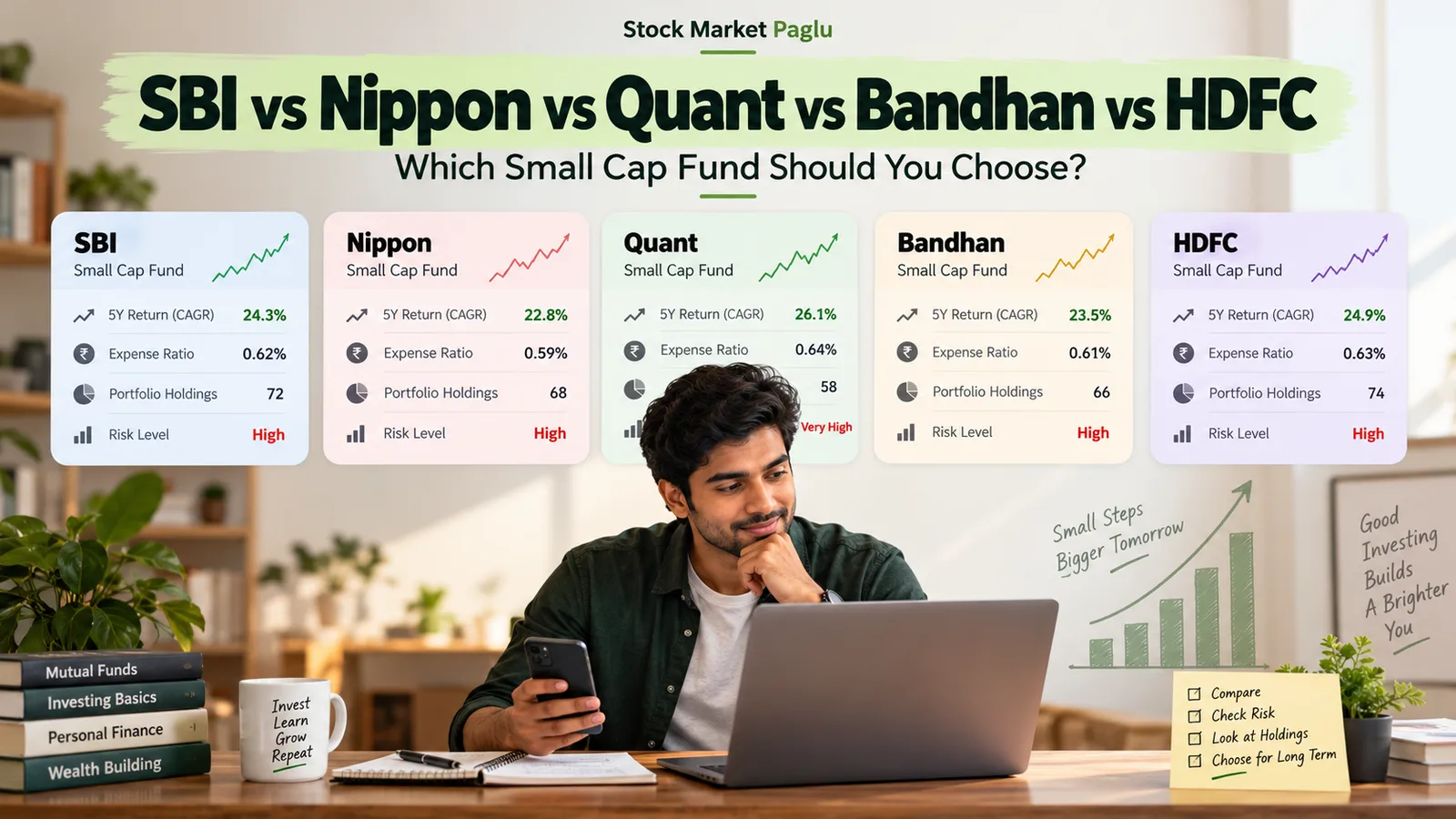
SBI vs Nippon vs Quant vs Bandhan vs HDFC: Which Small Cap Fund Should
I compared five popular small cap mutual funds. Here's what I found.
The short version
- Past returns don't guarantee future returns. Bandhan performed best over
- Not all small cap funds are alike. SBI held 63 stocks, while Nippon held
- Don't ignore liquidity risk. Smaller company shares can be difficult to sell
- Charges matter. Expense ratios ranged from 0.65% to 0.92%. Even small
Want to invest in small caps? or just want to know what they are?
Great! You have come to the right place.
I decided to compare their returns, charges, investments and risks. So you don't have to. (Although I suggest you to before you invest in anthing. Please!!!)
The results were quite interesting.
Over my career I have been asked a lot of questions about small cap and today I would try to answer all the relevant questions. So sorry, uncle! I can't tell you which small cap stock would give you 600% returns. But I promise to demystify small cap funds for you.
What exactly is a Small Cap Fund?
In India, listed companies are divided into three groups based on their market value.
- Large Cap: The biggest 100 companies.
- Mid Cap: Companies ranked 101 to 250.
- Small Cap: Companies ranked 251 onwards.
A small cap mutual fund must invest at least 65% of its assets in small cap companies.
Great now that we have covered that it brings me to the next question
Why invest in small companies?
Investing in small-cap companies can be more lucrative than investing in large-cap companies.
The reason ?
A company worth ₹1,000 crore may find it easier to double its business than an established company worth ₹5 lakh crore.
As small companies expand, increase profits, and gain market share, their stock prices can rise significantly.
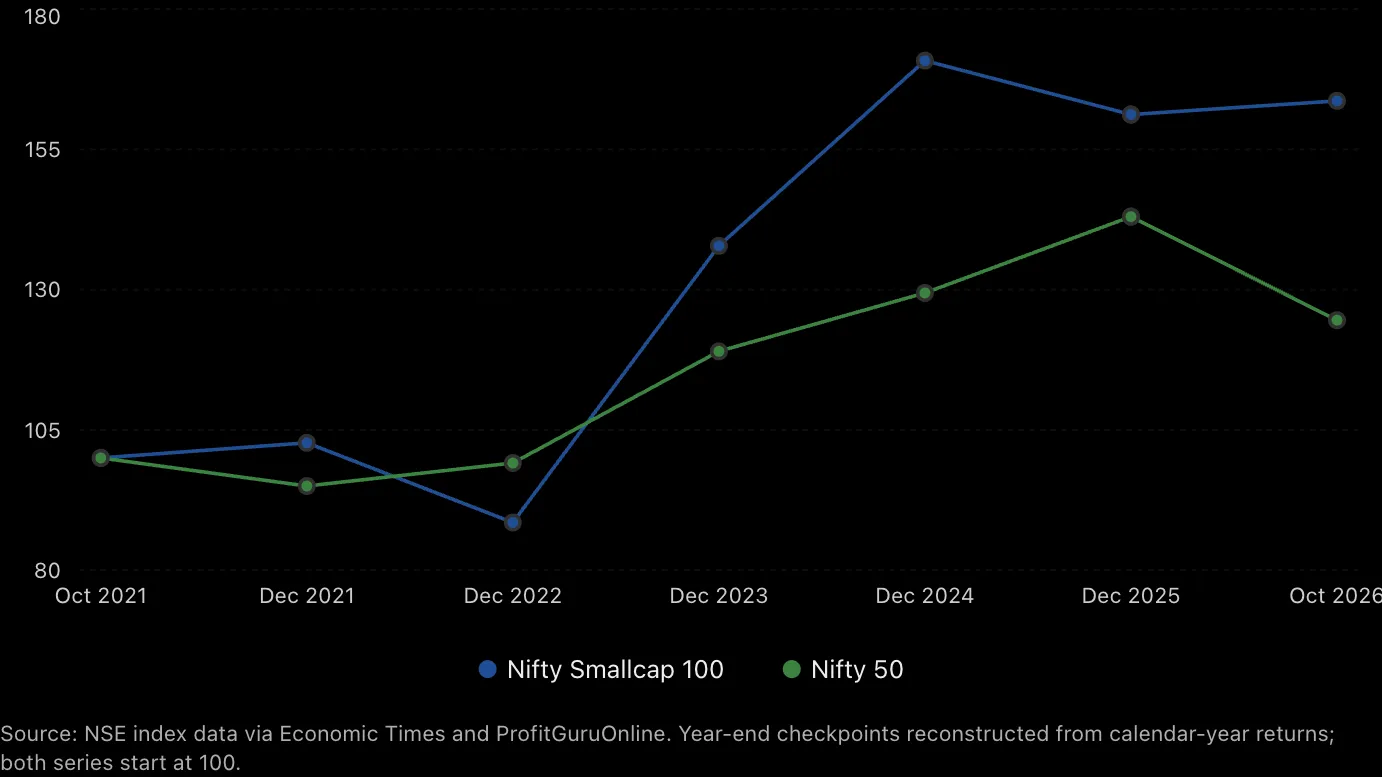
Smallcaps delivered approximately 2.6 times the cumulative return of Nifty 50 over this period.
Now that you know there is higher profits, you should also know this\ \ They also suffered much sharper corrections, including a 13.8% decline in 2022.
Higher potential returns come with greater volatility.
Great Chaks!, Thanks for telling us what I already know!!! Can you please tell me which mutual funds to put my money in?
Yeah, Yeah!!
Lets compare 5 mutual funds and understand what makes them different!
I selected five most popular small cap mutual funds and compared their Direct Growth plans.
##### Direct Growth Mutual Funds invest your money without distributor commissions (Direct) and automatically reinvest profits compounding over time.
| Mutual Fund | 1-Year Return | 3-Year CAGR | 5-Year CAGR |
|---|---|---|---|
| Bandhan Small Cap | +2.3% | 22.1% | 18.0% |
| Quant Small Cap | +3.8% | 16.4% | 16.5% |
| Nippon India Small Cap | \-1.4% | 12.6% | 16.5% |
| SBI Small Cap | \-2.3% | 9.5% | 11.4% |
| HDFC Small Cap | \-8.7% | 8.9% | 13.0% |
CAGR simply means the average yearly growth rate after accounting for compounding.
Bandhan Small Cap delivered 22.1% annualised returns over three years, while SBI Small Cap delivered only 9.5%.
That's a big difference.
Also, HDFC Bank delivered -8.7% last year.
This tells us something important: A fund can perform well over five years and still lose money in a particular year.
What if you invested ₹10,000 in these funds, five years ago?
| Mutual Fund | Investment | Value After 5 Years |
|---|---|---|
| Bandhan Small Cap | ₹10,000 | ₹22,878 |
| Quant Small Cap | ₹10,000 | ₹21,460 |
| Nippon India Small Cap | ₹10,000 | ₹21,460 |
| HDFC Small Cap | ₹10,000 | ₹18,424 |
| SBI Small Cap | ₹10,000 | ₹17,156 |
These are approximate calculations from rounded CAGR figures, not an exact NAV-based backtest. Taxes and exit loads are excluded.
The difference between Bandhan and SBI comes to nearly ₹5,700.
Now imagine you had invested ₹1 lakh instead of ₹10,000.
The difference would be roughly ₹57,000.
So why did Bandhan perform better during this period?
Was its fund manager selecting better companies? Did its investments benefit from certain sectors doing well? Or did it take more risks?
We cannot answer those questions from returns alone.
So I looked at what these funds actually own.
What companies are these funds buying?
| Mutual Fund | Stocks Held | Top 10 Holdings |
|---|---|---|
| Bandhan Small Cap | 261 | 17.3% |
| Nippon India Small Cap | 256 | 14.5% |
| Quant Small Cap | 104 | 36.1% |
| HDFC Small Cap | 85 | 25.4% |
| SBI Small Cap | 63 | 27.3% |
Nippon owns 256 stocks, while SBI owns just 63. Quant invests over a third of its money in only ten companies.
Some funds spread their investments widely, while others place bigger bets on fewer companies.
Neither approach guarantees better returns.
But,
Diversification does help mitigate risk. You can see how HDFC and SBI have the least diversification and lowest returns.
Do you know each fund has a expense to it, which effects the returns of the funds?
You might ask, what charges? or say Yeah, duh! I already know it
For those who don't know, it's called expense ratio and each fund has it's own.
The annual cost of running the fund, including managing its investments is called expense ratio.
| Mutual Fund | Expense Ratio |
|---|---|
| Bandhan Small Cap | 0.65% |
| Nippon India Small Cap | 0.68% |
| HDFC Small Cap | 0.79% |
| SBI Small Cap | 0.81% |
| Quant Small Cap | 0.92% |
Here is a comparison between the expense ratio of the top five most popular mutual fund.
To understand the difference, imagine a fund charges an expense ratio of 1%.
That's roughly ₹100 annually for every ₹10,000 of average assets, although the actual amount changes with the fund's value.
You don't receive a separate bill for this. These expenses are reflected in the fund's NAV.
And the historical returns we compared earlier already include these charges.
Regular fund have higher expense ration than direct mutual fund. Because it included seller comission.
So next time someone sweetly says, “Sir, yeh mutual fund best hai, trust me!” before trusting them, ask, “Direct plan hai ya aapki commission bhi meri SIP se jayegi?” 😂
There's another risk most investors don't check
Imagine you've invested in a small cap fund.
One day, the market starts falling, and thousands of investors decide to withdraw their money.
To pay investors, the fund might need to sell some of its shares.
But here's the problem.
Smaller company shares can be harder to sell in large quantities without affecting their prices.
This is called liquidity risk.
In September 2026, industry stress-test estimates showed the following time needed to sell half of each fund's portfolio under the test assumptions.
| Mutual Fund | Estimated Days |
|---|---|
| Bandhan Small Cap | 19 |
| Nippon India Small Cap | 27 |
| Quant Small Cap | 46 |
| SBI Small Cap | 51 |
| HDFC Small Cap | 52 |
Now, don't misunderstand this table.
It doesn't mean you'll have to wait 52 days to withdraw your money from HDFC Small Cap.
These figures estimate how long the fund itself might take to sell a large part of its underlying investments, using the stress-test method.
Normal investor redemptions are a separate process.
But the numbers tell us that some portfolios may be harder to liquidate than others.
And that's worth knowing before investing.
So, which fund is better?
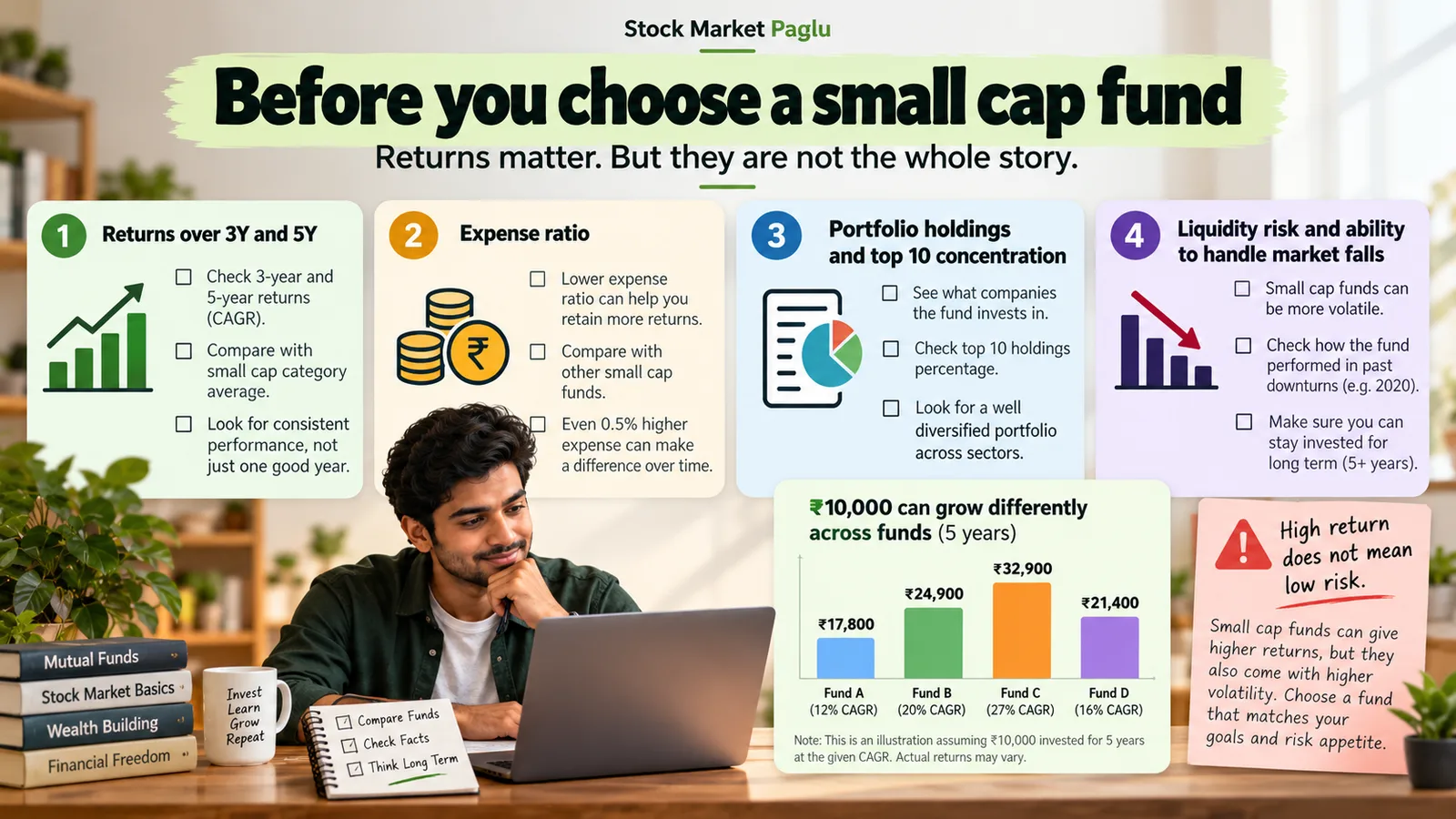
After comparing these five funds, here's what I found.
Bandhan Small Cap had the highest three-year and five-year returns in this comparison. It also had one of the lowest expense ratios.
Nippon India Small Cap managed the largest amount of money among these funds and spread its investments across more than 250 stocks.
Quant Small Cap delivered relatively strong historical returns, but had the highest expense ratio and the largest top-ten concentration.
SBI Small Cap held fewer companies and had lower three-year and five-year returns during this period.
HDFC Small Cap had a more concentrated portfolio than Nippon or Bandhan and recorded the weakest one-year return of the five.
Does that mean everyone should invest in Bandhan?
No.
These numbers tell us how the funds have performed and where they've invested. They don't tell us which fund will perform best next year.
Before making a decision, I would also want to see how each fund performed during market crashes, how often it beat its benchmark, and whether its investment strategy has changed.
Those questions matter just as much as the returns.
One last thing
When you search for the best small cap mutual fund, most apps will show you a list sorted by returns.
And it's tempting to pick the one at the top.
But after comparing these five funds, I think it's worth spending a little more time understanding what you're buying.
Look at the companies the fund owns. Check its charges. Understand how much it can fall.
And please remember our first article on emergency funds
Money you might need during an emergency shouldn't be invested in something that can fall sharply.
You don't need to predict which fund will give the highest returns next year.
You need to know what you're investing in and whether you can handle the risk.
Sources and data
- October 2026 Small Cap Fund Comparison
- AMFI — Mutual Fund Data
- AMFI — Liquidity Stress Tests
- SBI Small Cap Portfolio
- Nippon India Small Cap Portfolio
- Quant Small Cap Portfolio
- Bandhan Small Cap Portfolio
- HDFC Small Cap Portfolio
This article is for education only and is not personalised investment advice. Returns shown are illustrations, not forecasts. Rules and rates change, so check the latest information and consider a SEBI-registered adviser for decisions about your own money.
We explain Indian personal finance in plain language, show our assumptions and never take money to recommend a product. Read our editorial policy.