Beginner's Guide | How Do You Know If a Company Is Worth Investing In?
You've understood what stocks are. Now comes the difficult part. Which one should you buy?


When I started investing 12 years ago and looked at this question.
I googled "Best stocks to buy in India".
You might have done it as well.
One website recommends Tata Motors, another says Reliance, and some guy on YouTube is promising 10x returns from a company you've never heard of.
But here's something I want you to understand.
Picking a stock means picking a business. Not guessing which share price will go up tomorrow.
So how do you pick a business?
Start With Companies You Already Know
Look around your house.
You probably have a Britannia biscuit packet somewhere. Maybe you use an Airtel SIM, own a Maruti car or have an account with HDFC Bank.
These are real businesses selling real products.
Pick one that interests you.
Let's say Britannia.
You know what it sells. You've probably eaten its biscuits. You might even know its competitors.
That's a good start.
But please don't buy Britannia shares just because you like Good Day biscuits!
We still have some homework to do.
Is the Business Actually Making Money?
Remember Anita's Kitchen?
One month, Anita makes ₹10 lakh in sales but spends ₹9 lakh running her stores. That's ₹1 lakh in profit.
Next month, sales increase to ₹12 lakh, but expenses reach ₹12.5 lakh.
More sales, but a ₹50,000 loss!
That's why we check two things:
- Revenue: Money earned from sales.
- Profit: Money left after expenses.
You'll find both in a company's Profit & Loss statement.
But why check the last five years?
Because one good year doesn't tell us much. Maybe the company had a lucky year or a temporary increase in demand.
If sales and profits keep growing over several years, it's a better sign that the business is doing something right.
It doesn't guarantee future success, but it's a good place to start.
How Much Debt Does the Company Have?
Anita borrows ₹2 crore to open twenty more stores.
Nothing wrong with that. Businesses take loans to grow.
But what if her new stores don't make enough money? She still has to pay interest and repay the loan.
The same applies to listed companies.
Even a profitable company can struggle if it has too much debt.
That's why I check a company's borrowings and whether it earns enough to comfortably repay them.
A little debt isn't necessarily bad. But too much can turn a good business into a risky investment.
A Cheap Stock Doesn't Mean It'll Go Up
"Yaar, ₹2,000 ka share bahut mehenga hai. ₹50 wala lete hain!"
Sounds familiar?
But a lower share price doesn't mean a cheaper company.
To understand this, we use something called the P/E Ratio (Price-to-Earnings Ratio).
Let's say Anita's Kitchen earns ₹10 in annual profit per share.
- If its share price is ₹100, the P/E is 10.
- If its share price is ₹200, the P/E is 20.
In simple words, at a P/E of 20, investors are paying ₹20 for every ₹1 the company earns annually per share.
Why would someone pay more?
Maybe they expect Anita's business to grow faster in the future.
But higher expectations also mean greater disappointment if the business doesn't grow as expected.
A low P/E doesn't always mean a bargain, and a high P/E doesn't always mean a bad investment.
That's why we compare a company's P/E with similar businesses before deciding whether its shares are expensive.
Okay, But Where Do I Find All These Numbers?
This is the part I wish someone had shown me when I first started learning about stocks.
Go to Screener.in.
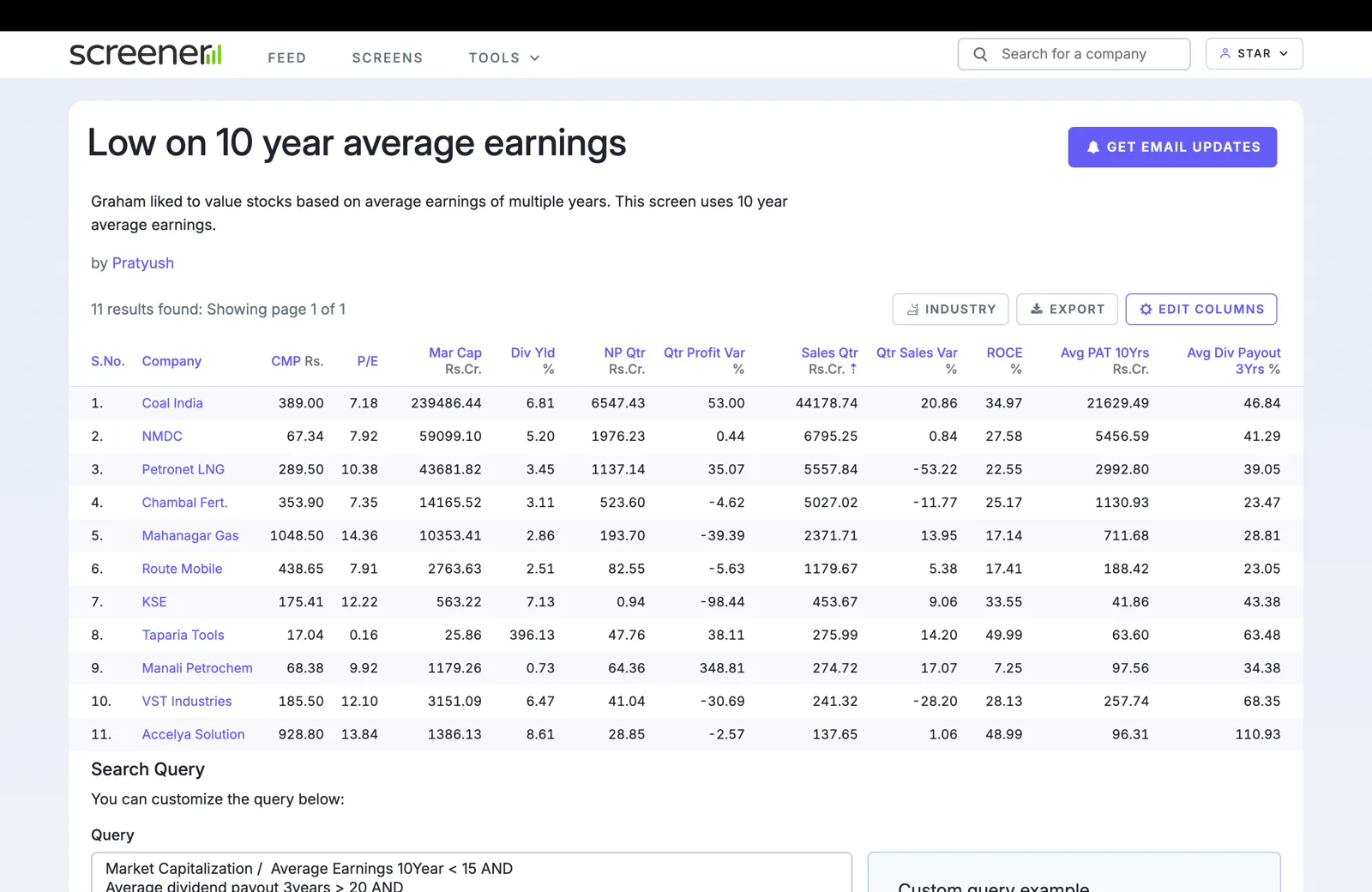
It's a website that brings together financial information about Indian companies.
Try this:
- Search for Britannia Industries.
- Open the Profit & Loss section. See whether sales and profits have grown over the last five years.
- Open the Balance Sheet section and look for borrowings.
- Scroll down to Peers to see other companies in the same industry.
That's it. You've started researching a real business.
The numbers won't tell you everything, and sometimes you'll need to read the company's annual report to understand what's happening.
You can find official reports and announcements on NSE India too.
So, Should You Buy the Stock?
Not so fast!
A company might have growing profits, low debt and great products. But that doesn't mean its shares are worth buying at any price.
We've learnt how to find a business worth looking at. Figuring out the right price to pay is another story. We'll cover that in the next article.
For now, here's some homework.
Pick three companies whose products you use. Look them up on Screener.in and check how their sales, profits and debt have changed over the last five years.
No need to buy anything yet. Just get comfortable reading the numbers.
And please, don't let some random Telegram stock tip do your homework for you!
One Last Thing
You don't need to find the next company that will give 1,000% returns (right now!!)
"You cannot make money on borrowed knowledge. Tips are hazardous for health." — Rakesh Jhunjhunwala
Start by learning how to recognise a decent business.
Some companies will look great until you check their profits. Others might have strong profits but too much debt.
And sometimes, you'll find a good business whose stock is simply too expensive.
Knowing when not to buy is also part of learning how to invest.
In the next article, we'll take an actual Indian company and go through its financial numbers together.
Disclaimer: This article is for educational purposes only, not investment advice. The companies mentioned are examples, not stock recommendations. Anita's Kitchen is fictional. Investments in securities markets carry risks.
This article is for education only and is not personalised investment advice. Returns shown are illustrations, not forecasts. Rules and rates change, so check the latest information and consider a SEBI-registered adviser for decisions about your own money.
We explain Indian personal finance in plain language, show our assumptions, never take money to recommend a product and label any referral links. Read our editorial policy.